|
The parish registers
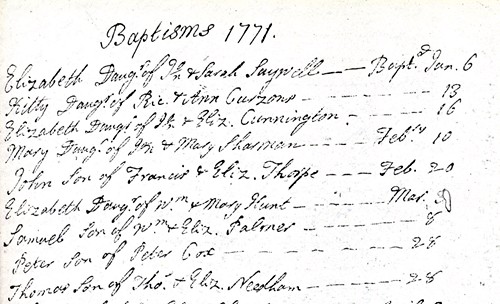
The register of baptisms for 1771 written by the Rev Humphrey Hyde
who was Vicar of Bourne from 1763 until his death in 1807.
The only way to check on births,
marriages and deaths from centuries past is by referring to the parish
registers. These are now difficult to access, the majority being deposited
for safe keeping with the county archives although some churches do have
copies and may be consulted by appointment.
It should also be understood that names particularly may not be accurate
because literacy was not universal. Parents, brides and grooms, and the
relatives of the dead, were often unable to read and write, which accounts
for the X or “their mark” on some certificates, while clerks, and
sometimes clergy themselves were not always completely literate and so the spellings
of names particularly may not be correct.
Church of England parish registers were first introduced in England and
Wales by a mandate dated 5th September 1538 from Thomas Cromwell, chief
minister to Henry VIII. Entries
of baptisms, marriages and burials were to be recorded in each parish and
written up weekly by the incumbent. Many of these early parish registers
were kept on loose sheets of paper or parchment.
In 1598, Queen Elizabeth I endorsed an order instructing the clergy to
keep their parish registers in parchment books and, at the same time, the
clergy were ordered to copy into these new registers the entries of
baptisms, marriages and burials made in earlier years, beginning in 1538 or from the
start of the reign of Queen Elizabeth I in 1558. Many incumbents chose the
latter date which is why so many of the earliest parish registers date
from 1558, rather than 1538.
Unfortunately not all have survived. Also, from
1598, parish clergymen were instructed to send an annual copy of all
baptisms, marriages and burials in their parish registers to the local
bishop although in some dioceses it had been customary to send them in
from much a earlier date. These regular listings are known as Bishop's
Transcripts and in some dioceses there were also other parish register
copies made which are called Archdeacon's Transcripts (not applicable to
the Diocese of Lincoln). Bishop's Transcripts, frequently abbreviated to
BTs, were usually submitted covering all the entries from one Lady Day
(March 25th) to the next. This is because until 1752 each New Year
actually began on Lady Day.
BTs tend to peter out around the middle of the 19th century, although in
some dioceses they continued into the latter half of the 19th century and
occasionally later. In Lincolnshire, there are very few BTs after the
1840s. The information on bishop's transcripts may sometimes differ from
the entries made in parish registers and family historians are advised to
check the entries of interest in both BTs and parish registers as either
record may contain additional information or events not recorded in the
other. BTs can be used as an alternative basic source if the parish
registers are missing but because the BTs were submitted annually on loose
paper or parchment gaps may occur where BTs themselves have been lost. BTs
are usually (not always) available in the same record repository as the
parish registers.
In Lincolnshire, both BTs and deposited parish registers are available in
the county archives. From the earliest years, it was usual for each
parish clergyman to keep baptism, marriage and burial entries in the same
register, usually known as a General Register. From 1653 to 1660, during
the Commonwealth Period when the country was under the control of Oliver
Cromwell's Protectorate, this role of the clergy was suspended and the
government appointed officials called Parish Registers (sic) to record
local events often in civil registers. Many of these men were lax with
their duties and few of their registers survive.
The first change to the general registers came in 1754 when, following the
Hardwicke Marriage Act, separate printed marriage registers, sometimes
incorporating banns books, were introduced. Couples were required to sign
or mark the entry of their marriage in the register before two witnesses.
The Hardwicke Act also made all other denominational marriages illegal,
except those carried out by Jews and Quakers.
In some parishes separate banns books were kept apart from the marriage
registers. From 1754, general registers should only contain details of
baptisms and burials but in a few parishes the clergy were slow to make
their marriage entries in the separate registers. George Rose's Act of
1812 introduced, from 1813, individual printed registers for entering
baptisms and burials and a slightly amended form of marriage register was
also introduced at the same time. The Church of England baptisms and
burials registers have remained largely unchanged since 1813, but the
marriage registers underwent considerable change from 1 July 1837 when
Civil Registration was introduced in England and Wales. Also, from 1837,
couples marrying could opt for a civil marriage in the local register
office or to marry in a nonconformist church or chapel providing certain
conditions were observed. Despite this relaxation, numbers of
nonconformist couples continued to marry in a Church of England church
until 1899 when, for the first time, Authorised Persons in licensed
nonconformist churches or chapels were allowed to keep their own marriage
registers.
|
Early parish registers for Bourne
which are known to survive are:
Baptisms, burials & marriages - 1562-1650
Baptisms 1651 - February 1717
Burials 1651 - March 1717
Marriages 1651 - 1716
Baptisms 27th March 1717 - 18th March 1759
Burials 25th March 1717 - 29th December 1758
Marriages 25th March 1717 - 24th March 1754
Marriages 1754 - 1779
Burials 1759 - 1812
Baptisms 1759 - 1812
Marriages 1780 - 1812
Bourne Poor Book Parish Rates 1731- 1754
Cawthorpe Town Book 1708 - 1775
I have copies of all those referred to above but there may be
others in the Lincolnshire County Archives and elsewhere and anyone
wishing to consult entries while researching their family tree is
advised to check. |
The parish registers are currently being
transcribed into digital format by David Tabor,
former church official, who began the task in 2011. Progress is slow
because the documents are hard to read and often illegible and a
painstaking attention to detail is required. But by March 2012, the work
was well advanced with three of the baptism registers completed comprising
some 2,400 entries from 1837-1899. "This has taken me three months", said
David, "and I anticipate that at least another 18 months of work lies
ahead."
The project is being undertaken with the approval of the vicar and
churchwardens who are the local custodians of the registers which are kept
under lock and key in the Abbey Church where David has been an active
worker for more than half a century. His first appointment was as a boy in
1950 when he joined the team of altar servers but in 1963 he was elected
to the parochial church council, becoming secretary the following year.
There have been many appointments since, at parochial and diocesan level,
including verger, parish clerk and churchwarden, a post which he
eventually gave up in 2002.
David lost his wife, Ann, in 2011. They had been married for almost fifty years.
Their daughter, Judith, an enthusiastic member of the Lincolnshire Family
History Society who has researched the Tabor family back to the 18th
century, suggested the transcription of the registers as a suitable
project and he has tackled it with enthusiasm. Once complete, it is hoped
that the registers will be available on the Internet through the
Lincolnshire Family History web site.
REVISED MARCH 2012
NOTE: I am indebted to an article by Tom
Wood on parish registers published by the
Lincolnshire Family History Society’s magazine in 1994 (Volume 5 Number 4)
for information used while writing this item
See also David
Tabor

Go to:
Main Index Villages
Index
|