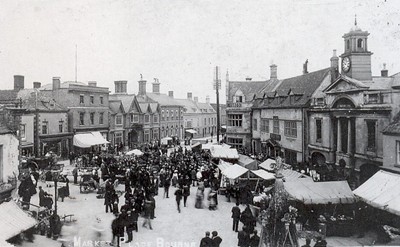
Bourne market in 1910, often a place for drunken behaviour
SIGNING THE PLEDGE TO FIGHT
THE DEMON DRINK
by Rex Needle
Bourne market in 1910, often a place for drunken behaviour
SIGNING THE PLEDGE TO FIGHT
THE DEMON DRINK
by Rex Needle
|
A BELIEF THAT the excessive consumption of alcohol was directly linked with social, moral and physical evils became manifest in England during the 19th century when the temperance movement flourished. It originated in 1826 with the intention of prohibiting the use of alcohol and placing the liquor sales under official control with the profits being used for public purposes, the introduction of counter attractions, high licence fees and taxation. Temperance organisations such as the Band of Hope taught the principles of sobriety and teetotalism. They were fully supported by the church and public meetings usually had a religious flavour with rousing hymns and fire and brimstone speeches from local clergymen. Visiting speakers were so effective that members of the audience would leave their seats in a mesmerised state and queue up on the stage amid cheers to sign the pledge, a document vowing total abstinence in the future. Public witness was a favourite method of promising to give up alcohol because the stigma of over indulgence was, in many cases, deeply felt. For instance, in the autumn of 1854, Thomas Fracey, a fruit and fish hawker trading at Bourne market, was brought before the local magistrates accused of drunkenness and abusive behaviour while running his stall on market day and was fined five shillings. Fracey was mortified by his conduct and the following week, asked the local newspaper to publish an apology on his behalf which they did on November 10th adding: "It is hoped that he will forthwith enrol himself a member of a teetotal society." A Temperance Society was formed in Bourne in 1863 and organised frequent gatherings in various public halls such as that on Friday 31st January 1868 which took the form of a social gathering of members and friends at the mission school in Eastgate [demolished in 1960] when 300 people sat down to tea followed by a public meeting at which readings, recitations and speeches were given, interspersed with music and singing. A local newspaper reported: “The school was crowded and great interest was manifested throughout the meeting, at the close of which, a vote of thanks was passed by acclamation to the Rev Joseph Dodsworth, the Vicar of Bourne, for his kindness in granting the use of the room. We hear that several persons signed the pledge.” Similar meetings consolidated the activities of the society which was soon inviting guest speakers, often from abroad, to address them. On Saturday 15th January 1870, they were host to Josephus Cheaney, widely publicised as "the American boy orator" who was then touring the country with his message against the evils of drink. The meeting was held at the Victoria Hall in Eastgate [demolished in 1967] where he delivered two lectures on the themes of abstinence, both of which were listened to with undivided attention by a crowded audience. Tea was provided afterwards for the 100 people who attended and ten of them signed the pledge. But not all temperance gatherings were of a peaceful nature, as one visiting speaker discovered in 1863 because the newspaper reported on Friday 10th June: “On Monday evening, the vicinity of the Ostler fountain in the Market Place was for two hours the scene of a riotous tumult in consequence of Mr Grayson attempting to lecture on teetotalism from the steps of the fountain, and the non-abstainers being as determined to prevent him. During that time, a quantity of ale was brought out and partaken of with great apparent gusto. It is to be lamented that there was a considerable amount of intemperance exhibited by both parties and it appears to be the opinion of the more quiet part of the audience that the exertions of each would be better confined to their respective spheres of action.” A second organisation opposed to alcohol formed in 1874 was known as the Bourne Total Abstinence Association which held its meetings at the Corn Exchange, usually public teas and lectures with a strong emphasis on family involvement. Open air meetings were also popular, especially in the surrounding villages such as Thurlby, Edenham and Rippingale, while a temperance weekend camp was held at Castle Bytham where 30 people signed the pledge. In 1880, Mr Harry Goodyer opened a Temperance Café and Working Men’s Institute in South Street and a limited company was formed to run it and although it enjoyed some success over the next five years, the venture soon encountered financial difficulties and eventually went into voluntary liquidation with debts of almost £200 although the café was revived for a time afterwards, continuing on a voluntary basis as a public institute and library. Many visitors to the town did not wish to stay in hotels which served alcohol and so in 1896, the premises were converted for use as the Willoughby Temperance Hotel but this too had a short life, closing in 1901 when the proprietor, Mr Goodyer, left to begin a new career as Bourne’s school attendance officer. The temperance movement continually claimed that its activities were having an effect on the drinking habits of the population and an apparent reduction in cases of drunkenness in Bourne during the late 19th century is indicated by a report in 1890 to the Brewster Sessions, the annual meeting of magistrates sitting as licensing justices to consider the conduct of public houses and to renew or refuse licences for incoming landlords. Superintendent Willerton Brown, who was in charge of the local police force, detailed the convictions for drunkenness in the town during the previous twelve years, dropping from 221 in 1878 to only 53 in 1889 and added: “These figures will give the temperance party in Bourne unqualified delight.” The population of Bourne at that time was 4,191 (1891 census). By the mid-20th century, the temperance movement had largely disappeared because of changing social and cultural habits in which drinking had become an accepted practice in all walks of life. Today, liquor in all of its forms, spirits, wine and beer, can be bought at supermarkets, grocery stores and even garages although the social taboos of past times have now been replaced by concerns of its effect on health through over indulgence. |
NOTE: This article was published by The Local newspaper on Friday 4th May 2012.
Return to List of articles