PUTTING THE BOURNE PARISH
REGISTERS ONLINE
by Rex Needle
PUTTING THE BOURNE PARISH
REGISTERS ONLINE
by Rex Needle
|
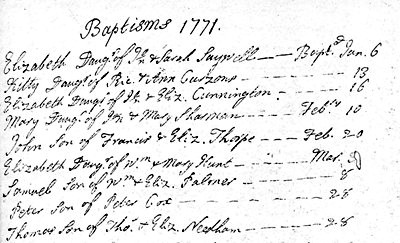
THE ONLY WAY THE CHECK on births, marriages and deaths from centuries past is by referring to the parish registers. These are difficult to access, the majority being deposited for safe keeping with the county archives although some churches do have copies but usually they can only be consulted by appointment. Now the mammoth task of copying the parish registers for Bourne into digital format has begun in order that they can be available to anyone researching their family tree. The work is being undertaken by David Tabor, aged 74, of Maple Gardens, Bourne, long time voluntary worker for the Abbey Church, who admits that the task will be protracted and time-consuming. Church of England parish registers were first introduced in England and Wales by a mandate dated 5th September 1538 from Thomas Cromwell, chief minister to Henry VIII. Entries of baptisms, marriages and burials were to be recorded in each parish and written up weekly by the incumbent and many of these early registers were kept on loose sheets of paper. In 1598, Queen Elizabeth I endorsed an order instructing the clergy to keep their parish registers in parchment books and, at the same time, the clergy were instructed to copy into these new registers the entries of baptisms, marriages and burials made in earlier years, either from 1538 or from the start of the reign of Queen Elizabeth I in 1558. Many incumbents chose the latter date which is why a great number of the earliest parish registers date from 1558, rather than 1538. Unfortunately not all have survived but the earliest known to exist for Bourne are the baptisms, burials and marriages for the years from 1562-1650, then through to the present day. There are pitfalls in making copies. In later years, the task of keeping the parish registers was given to the parish clerk or some other nominated official within the church but the entries in these early registers, particularly the names, may not always be accurate because literacy was not universal. Parents, brides and grooms, and the relatives of the dead, were often unable to read and write, which accounts for the X or “their mark” on some certificates, while parish clerks, and sometimes the clergy themselves were not always completely literate and so the spellings of names particularly may not be correct and even though some are quite ordinary, they were often misheard and therefore wrongly interpreted at the time of writing, entered phonetically or simply misspelled. This has produced a number of oddities in the Bourne registers, particularly among first names. One such instance occurred with the baptisms at the Abbey Church during the 16th century because a baby boy was registered on 22nd March 1575 as Ewstis Carter although this most probably should have been Eustace Carter. There are many other anomalies and William frequently appears as Willyam or Wyllyame, Henry as Henrye, Philip as Philippe, Judith as Judythe and Eleanor as Elliner. In addition, some of the entries have become illegible or difficult to read and so a painstaking attention to detail is required, making the task of copying a slow one. David Tabor was aware of the problems involved when he began work in 2011 and by August this year the task was well advanced with the baptism registers almost finished, comprising some 8,600 entries from 1837-1965. Burials from 1651-1843 were also completed, a further 9,300 entries but there are still another century of entries to copy. "This has taken me a year", he said, "and I anticipate that at least another twelve months of work lies ahead mainly because the marriage registers will be more complex." The project is being undertaken with the approval of the vicar and churchwardens who are the local custodians of the registers which are kept under lock and key in the Abbey Church where David has been an active worker for more than half a century. His first appointment was as a boy in 1950 when he joined the team of altar servers but in 1963 he was elected to the parochial church council, becoming secretary the following year. There have been many appointments since, at parochial and diocesan level, including verger, parish clerk and churchwarden, a post which he eventually gave up in 2002. David lost his wife, Ann, in 2011, aged 71. They had been married for almost fifty years. Their daughter, Judith, an enthusiastic member of the Lincolnshire Family History Society who has researched the Tabor family back to the 17th century, suggested the transcription of the registers as a suitable project and he has tackled it with enthusiasm. Once complete, it is hoped that the registers will be available on the Internet through the Lincolnshire Family History web site. In view of the increasing interest in tracing ancestors, this is a worthwhile task and one that will be welcomed by anyone trying to trace their ancestors and compile their family tree. The project will also be of tremendous help to visitors of the Bourne web site which currently has more than 400 names connected with the town listed for research in its Family History section by descendants living around the world. Over the past fourteen years, this facility has put people in touch with relatives they never knew existed and enabled them expand their family trees considerably and so once the parish registers become available online, they will provide a further source of material. Genealogy has become one of the most popular pursuits of Internet users, a facility that allows them check official records that were once inaccessible and enables them contact people researching the same name with the likelihood that you may come from that family. It is a thrilling adventure and one that may also produce some unexpected, even unwanted, information because you are just as likely to discover a criminal as a countess among your antecedents, but then that is all part of the excitement. |
NOTE: This article was published by The Local newspaper on Friday 7th September 2012.
Return to List of articles